Key points
- Medicare doesn’t pay for most long-term care, which is help with daily activities (Medicare.gov).
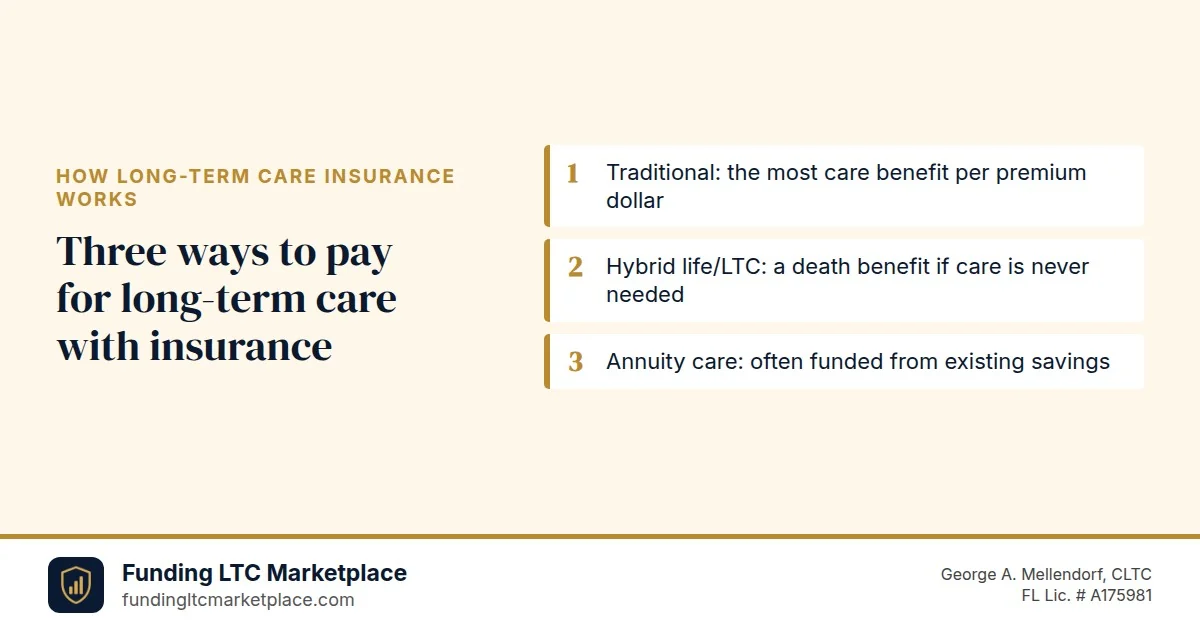
- Traditional LTC insurance pays only for qualifying care and usually has the lowest premium for the most benefit.
- Hybrid life/LTC adds a death benefit if care is never needed, so the money isn’t lost.
- Annuity-based care can turn existing savings into a larger pool for care.
Most people learn that Medicare doesn’t pay for ongoing long-term care at the worst possible moment: when a parent needs help and the bills begin. Insurance is one of the few ways to plan for that cost in advance, and there are three main types.
Why insurance matters here
Someone turning 65 today has almost a 70% chance of needing some type of long-term care (ACL). Most of that care is help with bathing, dressing, eating and supervision, and Medicare.gov is clear that Medicare doesn’t pay for long-term custodial care. Without a plan, families pay from savings until they qualify for Medicaid.
1. Traditional long-term care insurance
A traditional policy is stand-alone coverage that pays only for qualifying long-term care, at home, in assisted living or in a nursing home. You choose a benefit amount, a benefit period, an elimination period (the waiting period before benefits start) and often inflation protection.
- Strength: usually the most care coverage for each premium dollar.
- Trade-off: if you never need care, the premiums don’t come back, and premiums on many older policies have increased over time.
- Underwriting: full medical underwriting, so it’s easiest to qualify in your 50s and early 60s.
2. Hybrid life and long-term care
A hybrid is permanent life insurance with a long-term care benefit built in. If you need care, the policy pays for it. If you never do, a death benefit goes to your beneficiaries.
- Strength: the money is used one way or another, and premiums are often guaranteed.
- Trade-off: higher premiums, often paid as a lump sum or over a set number of years.
- Underwriting: medical underwriting, sometimes more forgiving than traditional coverage.
3. Annuity care
Annuity-based care pairs a deferred annuity with long-term care benefits. It is often funded with savings you already have, and if care is needed, the benefit can be a multiple of the annuity’s value.
- Strength: it repositions existing assets rather than adding a new monthly bill.
- Trade-off: it ties up a lump sum, and features vary widely by carrier.
- Underwriting: often simplified, which can help people who wouldn’t qualify for other coverage.
How to choose
The right choice depends on your age, your health, your budget and what you want to happen to the money if care is never needed. Many people compare all three side by side for the same benefit amount. Our guide to how long-term care insurance works explains each step, and the AALTCI 2026 price index shows how much age and benefit design affect cost.
In Florida, you have a 30-day free look to review a new policy and cancel for a refund (Florida DFS).
Common questions
What are the three types of long-term care insurance?
Traditional long-term care insurance, hybrid life and long-term care, and annuity-based long-term care. Each pays for qualifying care but differs in cost, flexibility and what happens if care is never needed.
What happens to a hybrid policy if I never need long-term care?
A death benefit is paid to your beneficiaries. Many hybrid policies also offer a return-of-premium feature. Details vary by carrier.
Is traditional or hybrid long-term care insurance cheaper?
For the same amount of care coverage, traditional insurance usually has a lower premium. Hybrid coverage costs more because it also includes a life insurance benefit.
Can I get long-term care coverage if I have health problems?
Possibly. Traditional and hybrid policies are medically underwritten. Annuity-based coverage often uses simplified underwriting. A licensed specialist can tell you what you’re likely to qualify for.
Sources
- Medicare.gov: Long-term care coverage — www.medicare.gov/coverage/long-term-care
- Administration for Community Living: How much care will you need? — acl.gov/ltc/basic-needs/how-much-care-will-you-need
- American Association for Long-Term Care Insurance: 2026 Long-Term Care Insurance Price Index — www.aaltci.org/2026-AALTCI-Long-Term-Care-Insurance-Price-Index
- Florida Department of Financial Services: Long-Term Care Overview — myfloridacfo.com/division/consumers/understanding-insurance/long-term-care-overv
Educational content only; not legal, tax or financial advice. Rules can change; confirm current details before you act.
Funding LTC Marketplace is operated by Central States Insurance Services, Inc., Ft. Myers, FL. George A. Mellendorf, CLTC, Florida licensed insurance agent, License # A175981, NPN # 538220. Verify at licenseesearch.fldfs.com/Licensee/211790. This is not an offer of insurance. Coverage, rates, and eligibility are determined by the issuing carrier through underwriting. Not affiliated with or endorsed by Medicare or any government agency.