Key points
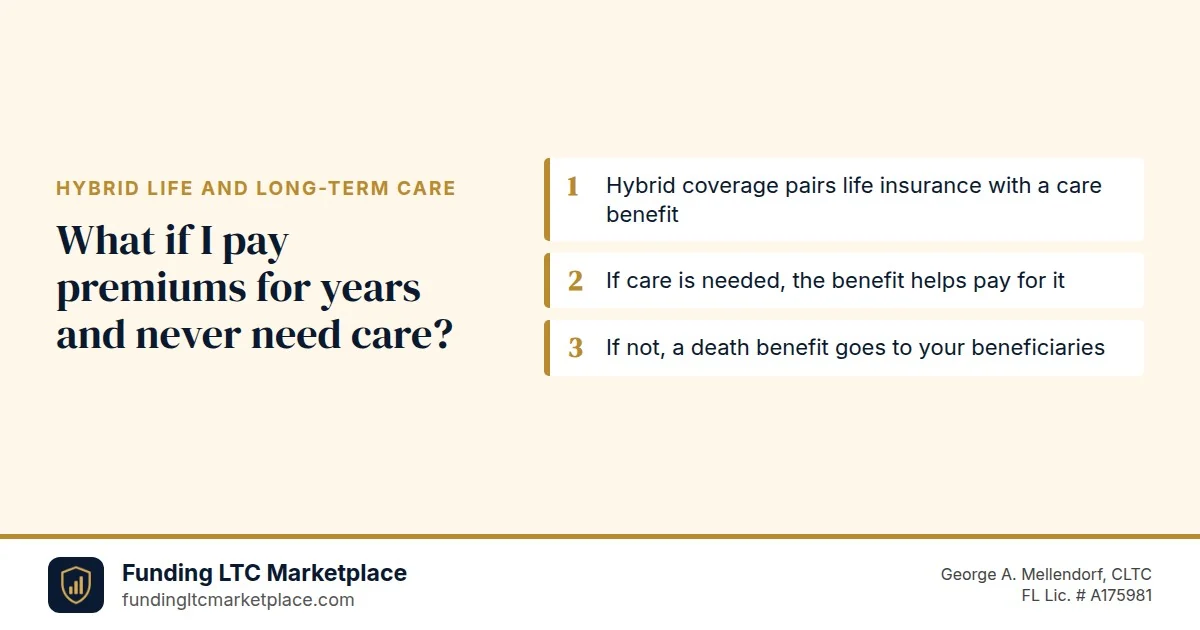
- A hybrid is permanent life insurance with a long-term care benefit. If care is never needed, a death benefit passes to beneficiaries.
- Hybrids now outsell stand-alone policies (Milliman).
- Ask about the monthly benefit, inflation growth, how benefits are paid and whether premiums are guaranteed.
- Ask whether you can get money back if you change your mind.
"What if I pay for years and never use it?" That’s the main reason people look at hybrid life and long-term care coverage. It’s a good answer to that worry. But hybrid policies differ widely, and these seven questions help you compare them.
Why hybrids are popular
Milliman estimates life/LTC hybrid sales reached 100,000 to 150,000 policies in 2024, compared with roughly 40,000 stand-alone policies (Milliman). Couples especially like that the money works either way: it pays for care, or it passes to the family.
1. How much does it pay per month, and for how long?
Look at the monthly long-term care benefit and the total pool. Many hybrids pay out the death benefit over a set period, then continue with an extension of benefits rider. A policy that pays $6,000 a month for six years is very different from one that pays $4,000 a month for three.
2. Is there inflation protection?
Care costs keep rising. Ask whether the long-term care benefit grows, by how much, and what it costs to add.
3. How are benefits paid?
Reimbursement policies pay actual care costs up to the monthly maximum. Indemnity or cash policies pay the full monthly benefit once you qualify, which gives more flexibility, including for family caregivers.
4. Are premiums guaranteed?
Many hybrids have guaranteed premiums, paid as a single deposit, over a set number of years or for life. Confirm which, and whether the insurer can ever raise them.
5. Can I get money back if I change my mind?
Many hybrids offer a return-of-premium or surrender feature. Ask what percentage is returned, and whether it changes over time.
6. What does the death benefit look like after care?
Long-term care benefits used generally reduce the death benefit. Ask whether there’s a residual death benefit even if the full pool is used.
7. Can I fund it with money I already have?
An old life insurance policy or annuity can often be moved into a hybrid through a tax-free 1035 exchange (IRS). Our 1035 exchange guide explains how.
Underwriting
Hybrid underwriting is often more forgiving than traditional coverage, but it also considers conditions that affect life expectancy. Our underwriting guide explains what to expect.
Compare it with the other two
A hybrid isn’t right for everyone. For the same care benefit, traditional coverage usually costs less, and annuity care can be easier to qualify for. See how long-term care insurance works for a side-by-side view.
Common questions
What is a hybrid life and long-term care policy?
Permanent life insurance with a long-term care benefit. If care is needed, the policy helps pay for it. If care is never needed, a death benefit passes to your beneficiaries.
Are hybrid long-term care premiums guaranteed?
Many are, whether paid as a single deposit, over a set number of years or for life. Confirm with the specific policy.
What's the difference between reimbursement and indemnity benefits?
Reimbursement policies pay actual care costs up to a monthly maximum. Indemnity or cash policies pay the full monthly benefit once you qualify, regardless of actual costs.
Can I get my money back from a hybrid policy?
Many hybrids offer a return-of-premium or surrender feature. The amount and terms vary by policy.
Sources
- Milliman: Annuity Market Update, Q1 2026 — media.milliman.com/v1/media/edge/images/millimaninc5660-milliman6442-prod27d5-00
- IRS Notice 2011-68: Long-term care riders on life insurance and annuity contracts — www.irs.gov/irb/2011-36_IRB
Educational content only; not legal, tax or financial advice. Rules can change; confirm current details before you act.
Funding LTC Marketplace is operated by Central States Insurance Services, Inc., Ft. Myers, FL. George A. Mellendorf, CLTC, Florida licensed insurance agent, License # A175981, NPN # 538220. Verify at licenseesearch.fldfs.com/Licensee/211790. This is not an offer of insurance. Coverage, rates, and eligibility are determined by the issuing carrier through underwriting. Not affiliated with or endorsed by Medicare or any government agency.