Key points
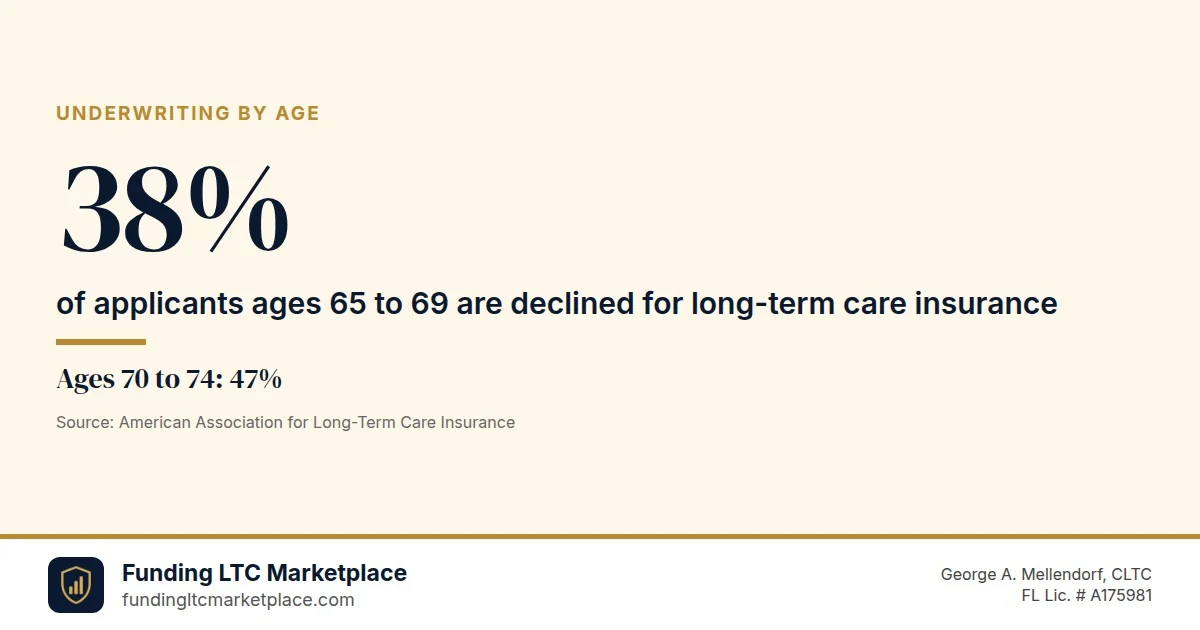
- AALTCI puts the decline rate at 38% for ages 65 to 69 and 47% for ages 70 to 74 (AALTCI).
- Milliman’s data shows declines rising from 18.1% in the 40s to 65.9% at 75 to 79 (Milliman).
- Insurers requested medical records for 89% of applications and ran prescription checks on 85%.
- The best time to apply is while you’re healthy.
Age is the single biggest driver of long-term care insurance declines, because health problems become more common every decade. The data makes the case for timing more clearly than any sales pitch could.
The data
| Applicant age | Declined | Placed |
|---|---|---|
| 40 to 49 | 18.1% | 67.6% |
| 50 to 59 | 23.8% | 63.7% |
| 60 to 64 | 32.7% | 52.7% |
| 65 to 69 | 43.0% | 44.0% |
| 70 to 74 | 50.1% | 36.9% |
| 75 to 79 | 65.9% | 25.5% |
Source: Milliman 2025 Long-Term Care Insurance Survey, stand-alone policies. AALTCI data shows the same pattern, with decline rates of 38% for ages 65 to 69 and 47% for ages 70 to 74 (AALTCI).
The average issue age for stand-alone policies was 56.1 in 2024. As George Mellendorf puts it: "When I first started in the ’nursing home insurance’ business in 1981, the average age was 74. Today we are down to the mid-50s and early 60s."
What underwriting looks at
In Milliman’s survey, insurers requested medical records for 89% of applications and ran prescription profiles on 85% (Milliman). Many also use a phone interview with a short memory screen, especially at older ages.
A federal study of declined applicants found no single diagnostic category accounts for more than 15% of declines. Leading categories included neurological disorders, fractures and musculoskeletal conditions, diabetes, cardiac conditions and stroke (ASPE).
How to prepare
- Apply while you’re healthy. A new diagnosis, a fall or a medication change can raise the price or rule out some options.
- Time it around your birthday. AALTCI suggests comparing costs 30 to 60 days before a birthday to lock in the lower age rate.
- Gather your history: doctors, diagnoses, medications and dates.
- Let a professional shop your health. An independent broker can compare how several insurers view your conditions before you apply.
If you’ve waited
A decline isn’t the end of the road. Hybrid life/LTC and annuity-based coverage are underwritten differently, and annuity care is often the most streamlined. Our guide to long-term care insurance underwriting explains what each looks like.
Common questions
What percentage of long-term care insurance applications are declined?
In Milliman’s 2025 survey, 24.3% of stand-alone applications were declined or deferred overall, rising with age from 18.1% in the 40s to 65.9% at ages 75 to 79.
What is the decline rate for long-term care insurance at 65?
AALTCI data puts the decline rate at 38% for applicants ages 65 to 69 and 47% for ages 70 to 74.
What do long-term care insurers check?
Most request medical records and run prescription checks, and many use a phone interview with a short memory screen.
When should I apply for long-term care insurance?
While you’re healthy, often in your 50s or early 60s. Comparing 30 to 60 days before a birthday can lock in the lower age rate.
Sources
- American Association for Long-Term Care Insurance: Consumer Research and Learning Center — www.aaltci.org/Consumer-Research-Learning-Center
- Milliman 2025 Long-Term Care Insurance Survey (Broker World) — brokerworldmag.com/wp-content/uploads/2025/12/2025-SurveyAnalysis-2025-12-16.pdf
- ASPE (HHS): A Profile of Declined Long-Term Care Insurance Applicants — aspe.hhs.gov/sites/default/files/private/pdf/76321/appJa.pdf
Educational content only; not legal, tax or financial advice. Rules can change; confirm current details before you act.
Funding LTC Marketplace is operated by Central States Insurance Services, Inc., Ft. Myers, FL. George A. Mellendorf, CLTC, Florida licensed insurance agent, License # A175981, NPN # 538220. Verify at licenseesearch.fldfs.com/Licensee/211790. This is not an offer of insurance. Coverage, rates, and eligibility are determined by the issuing carrier through underwriting. Not affiliated with or endorsed by Medicare or any government agency.